Record-scoped silence: our comment letter to the SEC
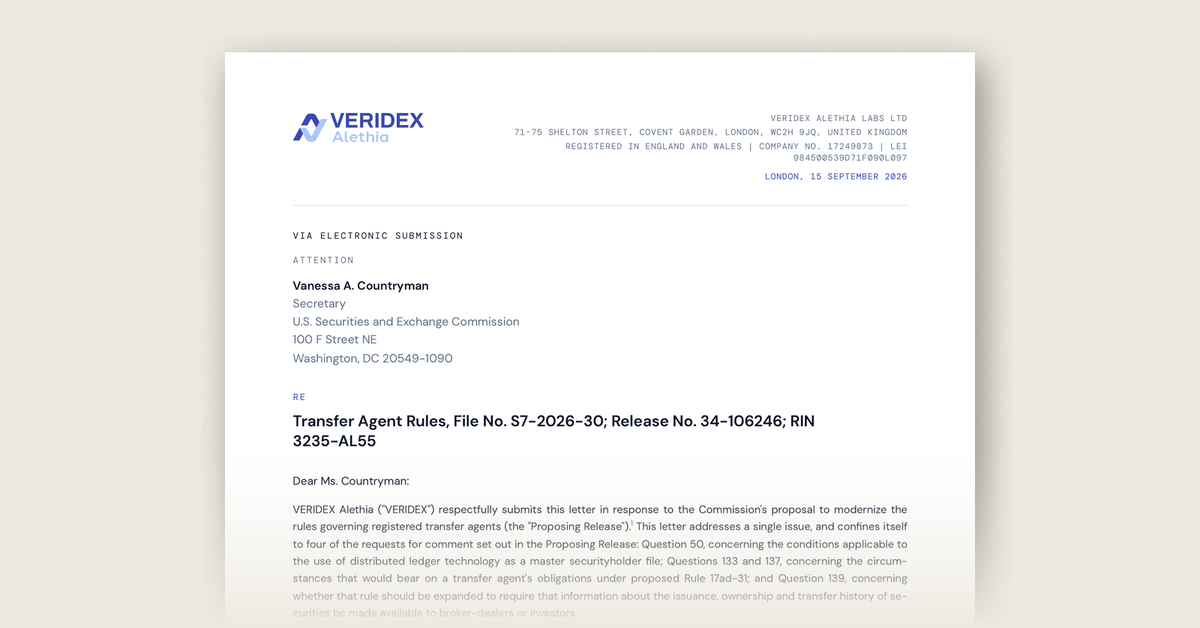
London, 16 September 2026. VERIDEX Alethia has filed a comment letter, dated 15 September, with the SEC on its proposal to modernise the rules for registered transfer agents, File No. S7-2026-30. The letter is now on the Commission's public docket.
In brief
The Commission published the proposal on 1 September 2026, and comments close on 3 November. The letter, dated 15 September, confines itself to one issue. Proposed Rule 17ad-31(b) would require a transfer agent to refrain from facilitating an unregistered securities transaction unless it has "a reasonable basis to believe that the transaction does not violate, or is not part of a chain of transactions that would violate, Section 5(a) of the Securities Act of 1933." Neither the proposal nor any provision of the rules and statutes examined for the letter prescribes a source from which the agent must obtain the information that would make that chain visible. The letter calls this an asymmetry between the duty imposed and the record available to discharge it, and asks the Commission to address both halves in the same rulemaking.
A duty the register cannot answer
The obligations transfer agents have always carried are discharged from their own records: keeping the master securityholder file, posting transfers promptly, meeting turnaround standards. Rule 17Ad-9(b) defines that file as "the official list of individual securityholder accounts." A list of accounts does not show a chain of transactions.
The proposal itself bears this out. On the letter's count of its complete text, as published by the Commission, the word "pledge" does not appear, nor does "collateral". "Liens" appears three times, each time about a transfer agent's own unsatisfied judgments or liens when it withdraws from registration. "Chain of transactions" appears nine times. The proposed safe harbor rests on the same premise, because it turns on whether the agent is aware of circumstances indicating a problem, and awareness depends on what someone was obliged to record or disclose.
Existing law does not fill the gap. Under UCC 8-106(g), an issuer or securities intermediary is not required to enter into a control agreement even when the registered owner or entitlement holder directs it, and is not required to confirm one to another party unless the registered owner or entitlement holder requests it. The definition of "financial institution" in the Bank Secrecy Act regulations does not list transfer agents. And the gap between the register and the party in interest predates tokenisation: in the Dell appraisal litigation, beneficial owners lost their appraisal rights because their custodial banks re-registered the shares in the names of the banks' own nominees after the appraisal demand. The economic position did not change. The record did, and the entitlement followed the record.
The Commission has been asked for this since 2019
The proposal's own Question 139 asks whether transfer agents should be required to make the issuance, ownership and transfer history of securities available to broker-dealers or investors. It supports that question with a single citation: seven final reports of the SEC Government-Business Forum on Small Business Capital Formation, issued between 2019 and 2026. Six of those seven reports carry a related recommendation. In 2019 it was the Forum's fourth-ranked priority; in 2020 it came first among the solutions proposed for its issue, with 60 per cent of the participants' prioritising votes. The letter's point is that the rulemaking which introduces the duty is the natural place to consider the disclosure that would let the duty be discharged.
What the letter recommends
- Question 50. The condition the proposal attaches to a distributed ledger used as the master securityholder file is that the agent keep "at all times exclusive control" over it. That protects the integrity of the record. It does not show whether an agent holding such a file could substantiate the determinations the new rule requires. The letter asks that any condition address the second point, not only the first.
- Questions 133 and 137. Publish the red-flag list and the guidance, and say in each case whether the agent is expected to obtain the underlying information, to receive it from another party, or to decline the transaction when it cannot be obtained.
- Question 139. Adopt the disclosure in this rulemaking: the transfer history as recorded by the agent, the dates of its entries, and an express statement of the period, sources and scope it covers.
- Proportionality. Calibrate the standard to what a transfer agent is able to obtain. On the Commission's own figures, 143 of the 253 agents that filed Form TA-2 for 2025 received fewer than 1,000 items for transfer that year.
Record-scoped silence
The letter's central drafting point concerns statements that rest on an absence. A statement that no encumbrance has been recorded is a statement about a record, not about the right the record refers to. It can be made truthfully only as of a stated date, from stated sources and within a stated scope, and it asserts nothing about what those sources did not cover. Stated, those limits tell the recipient what was examined, from which sources and to what date. Omitted, they leave the recipient to infer a scope that no one undertook. The letter calls this discipline record-scoped silence.
The reasoning has an edge, and the letter draws it in principle. It applies to records whose silence carries no legal consequence, of which the master securityholder file is one. It does not apply where a legislature has attached a consequence to a missing entry. The letter gives no example of the second kind; one outside it is the United Kingdom's charges register: a charge that is not delivered to Companies House within the period the Companies Act 2006 allows is void against a liquidator, an administrator and a creditor of the company.
What the letter does not ask
The letter discloses at the outset that VERIDEX Alethia has a commercial interest in its subject. It does not ask the Commission to require any particular technology, distributed ledger technology included, or to endorse any provider, VERIDEX Alethia included. The disclosure it recommends is drawn from records transfer agents already keep and is neutral as to how they keep them. It does not suggest that registered transfer agents are failing their existing obligations. It does not constitute legal advice, a legal opinion, a title opinion, a lien search, a certification of compliance or a recommendation about any security, transfer or transaction.
The full letter, with its notes and citations, is on the SEC's public docket.